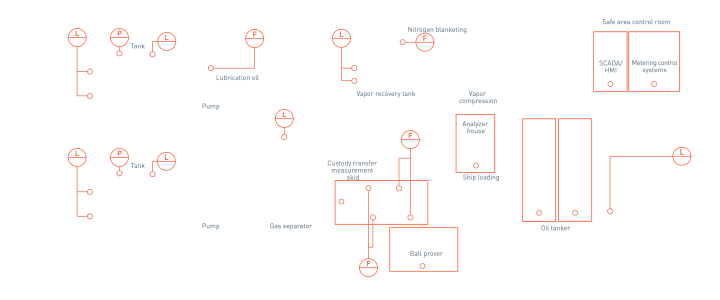
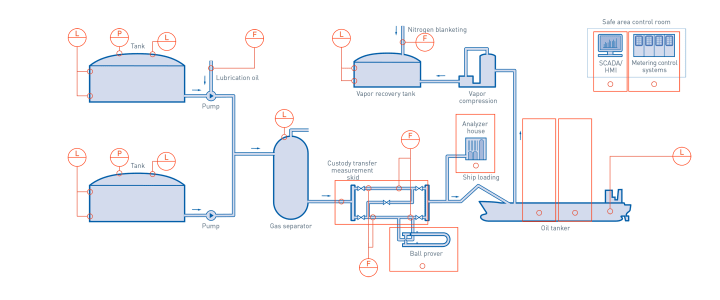
Ship loading in the chemical industry
Ship loading in the chemical industry – Tank level point detection
Ship loading in the chemical industry – Nitrogen blanketing pressure measurement
Ship loading in the chemical industry – Tank level measurement
Ship loading in the chemical industry – Pump lubrication monitoring
Ship loading in the chemical industry – Level measurement in degassers
Ship loading in the chemical industry – Continuous nitrogen blanketing
Ship loading in the chemical industry – Custody transfer metering systems
Ship loading in the chemical industry – Custody transfer measurement of crude oil or refined product
Ship loading in the chemical industry – Flow computing for custody transfer of crude oil or refined product
Ship loading in the chemical industry – Provers and master meters
Ship loading in the chemical industry – Sampling and analyser systems
Ship loading in the chemical industry – Fuel and emission monitoring
Ship loading in the chemical industry – Cargo monitoring system
Ship loading in the chemical industry – Metering control cabinets
Ship loading in the chemical industry – Supervisory and validation software
Ship loading in the chemical industry

설명

Tank level point detection

요구 사항

  • Avoid risk of overfill or dry run
  • Ensure continuous supply of crude oil or refined product

설명

Nitrogen blanketing pressure measurement

요구 사항

  • Ensure reliable blanketing

설명

Tank level measurement

요구 사항

  • Control of the tank farm
  • Inventory measurement

설명

Pump lubrication monitoring

요구 사항

  • Avoid damage to bearings of the pump
  • Indication of the flow

설명

Level measurement in degassers

요구 사항

  • Continuous measurement to adjust level in the degasser

설명

Continuous nitrogen blanketing

요구 사항

  • Maintenance of the non-explosive atmosphere
  • Low flows with mostly low pressures
  • Monitoring of minimum throughput

설명

Custody transfer metering systems

요구 사항

  • High-accuracy measurement of volume and quality of oil and refined products
  • Traceable to international standards
  • Complying with custody transfer requirements, Master/duty configuration with flowmeter diagnostics

설명

Custody transfer measurement of crude oil or refined product

요구 사항

  • High accuracy measurement of valuable products
  • Need for diagnostics to ensure measurement accuracy

설명

Flow computing for custody transfer of crude oil or refined product

요구 사항

  • High accuracy measurement of valuable products
  • Need for diagnostics to ensure measurement accuracy

설명

Provers and master meters

요구 사항

  • Fully certified according to local and international metrology requirements
  • Lowest possible measurement uncertainty
  • High reliability and low maintenance

설명

Sampling and analyser systems

요구 사항

  • Measurement of oil and refined product quality
  • Fully automated sampling during loading and unloading

설명

Fuel and emission monitoring

요구 사항

  • Onboard monitoring and reporting of fuel consumption and key emission data
  • Bunkering verification: monitoring and reporting of bunker quantities in loading lines
  • MRV compliant and verified acc. to EU regulation 2015/757

설명

Cargo monitoring system

요구 사항

  • Workstation with Cargomaster monitoring and alarm software
  • For full redundancy on monitoring, the system may be set up in multiple configurators

설명

Cargo monitoring system

요구 사항

  • Version with Horn antenna and ball valve optional
  • non-contact cargo level measurement of liquids

설명

Metering control cabinets

요구 사항

  • Integration of flow computers, PLCs, supervisory computers and printers
  • Installation of single flow computers up to fully redundant cabinet
  • Complying with custody transfer requirements

설명

Supervisory and validation software

요구 사항

  • Visualisation and monitoring of critical processes
  • Control of reporting, trends and alarm handling
  • Statistical evaluation of measurement data

Overview

Ship loading in the chemical industry

Custody transfer measurement of up and offloading processes

In the industry, the major product transported by sea has previously been crude oil. However, more and more refined products are also being transported by sea. Oil tankers deliver around 2.5 billion cubic meters of crude oil and refined products each year, and provide the next most efficient transport system after oil pipelines. Tanker sizes range from inland or coastal tankers that hold a few thousand cubic meters, up to ‘Ultra Large Crude Carriers’ (ULCC) that can hold up to 650,000 cubic meters. Tankers have different compartments and are often equipped with a marine tank monitoring and alarming system, such as the KROHNE CARGOMASTER, which uses radar-based level measurement sensors. Most tankers also have inert gas blanketing systems, using mainly nitrogen, that avoid the possibility of any explosive gas mixtures being present in the ullage space above the product.