










Overview
Oxyfuel in CCS processes
CO₂ recovery from oxygen-fired combustion processes
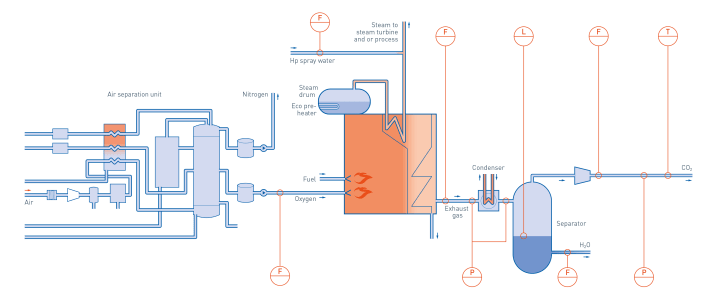
The oxyfuel process is an advanced combustion method designed to produce a highly concentrated stream of carbon dioxide (CO₂), making it easier to capture, store, or reuse. In this process, pure oxygen is first separated from air in an Air Separation Unit (ASU), typically using cryogenic distillation. The fuel – such as coal, natural gas, or biomass – is then combusted with pure oxygen instead of air. As a result, the flue gas contains mostly CO₂ and water vapour, with minimal nitrogen content.
The combustion and power generation process itself closely resembles conventional methods. After combustion, the flue gas is cooled, causing the water vapour to condense. This leaves a concentrated CO₂ stream, which is further purified to remove any residual gases or impurities.
The purified CO₂ is then compressed and can be stored in geological formations, used for enhanced oil recovery, or applied in various industrial processes – supporting efforts towards lower-carbon energy systems.Reliable process control is essential to the efficiency and safety of oxyfuel combustion systems.
KROHNE’s instrumentation ensures accurate measurement of key parameters such as oxygen supply, fuel feed, combustion temperature, and flue gas composition. From flow and pressure monitoring in the Air Separation Unit to precise level and temperature control in cooling and purification stages – KROHNE’s robust solutions support stable operation and optimal CO₂ capture.