






Juice production in the food & beverage industry
Juice production in the food & beverage industry –  Process pressure water supply
Juice production in the food & beverage industry –  Volumetric flow water
Juice production in the food & beverage industry –  Volumetric flow beet slurry
Juice production in the food & beverage industry –  Level measurement extraction tower
Juice production in the food & beverage industry –  Pressure measurement extraction tower
Juice production in the food & beverage industry –  Temperature measurement extraction tower
Juice production in the food & beverage industry –  Low level extraction tower
Juice production in the food & beverage industry – Process pressure
Juice production in the food & beverage industry

Description

Process pressure water supply

Requirements

  • Process control

Description

Volumetric flow water

Requirements

  • Process control

Description

Volumetric flow beet slurry

Requirements

  • Handling of high solid content

Description

Level measurement extraction tower

Requirements

  • Handling of dirty and volatile environment

Description

Pressure measurement extraction tower

Requirements

  • Process control

Description

Temperature measurement extraction tower

Requirements

  • Process control

Description

Low level extraction tower

Requirements

  • Process control

Description

Process pressure

Requirements

  • Process control

Overview

Juice production in sugar production

Handling of raw sugar beets

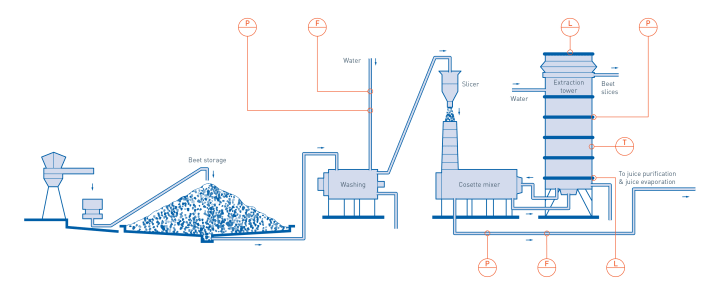
In juice production the raw sugar beet arrives at the mill yards, often delivered by the farmer direct. Quantities are monitored using a weighbridge, and the beet is mechanically unloaded, and stored in large open bays. After further washing, the beet are cut into v-shaped strips known as ‘cosettes’ in the slicer. The sugar extraction starts in the cossette scalder, where the strips are heated in water, and are then sent to an extraction tower. Water at 70°C is poured through the tower to extract the sugar and produce ‘raw juice’, which is sent on to the purification stages to extract the sugar. Further liquid is extracted from the cossettes by means of screw presses and these are then dried by hot air. Usually they are formed into pellets and sold for use in livestock feed and pet food.

The flow and temperature of the circulating liquids are monitored by the obstructionless OPTIFLUX electromagnetic flowmeters, and OPTITEMP probes and temperature transmitters. OPTIBAR pressure transmitters are used to monitor pressure in the water lines and the cossette juice extraction tower. Non-contact OPTIWAVE radar level transmitters can also measure the level of the mixture in the extraction tower.