PipePatrol NEO
Next Generation Pipeline Leak Detection, Theft Detection and Monitoring
Comprehensive pipeline protection all-in-one solution for maximum safety and operational reliability
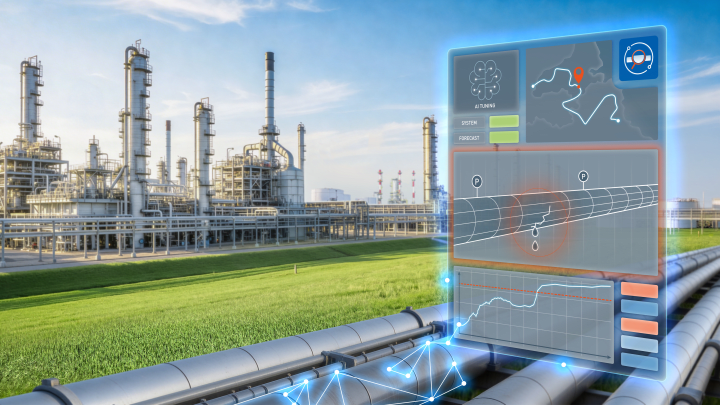
Future-ready AI-enhanced multi-method pipeline monitoring, increasing efficiency and long-term pipeline performance
Continuously improving performance adapts to changing conditions
Flexible and scalable architecture due to modular functionality
What does PipePatrol NEO for pipeline leak detection, management and monitoring include?
PipePatrol NEO by KROHNE is a comprehensive pipeline monitoring solution designed to ensure maximum safety, operational reliability, and asset protection. Built to address the complex risks pipelines face from corrosion and equipment failure to third-party interference, illegal tapping, and environmental impacts, the system combines monitoring technologies in one intelligent platform.
PipePatrol NEO applies an AI-enhanced multi-method approach that integrates proven physics-based models, statistical pattern recognition, and real-time measurements of flow, pressure, and temperature. The system continuously learns from operational data, adapting to changing conditions and delivering precise, reliable pipeline information in real time. This enables faster detection, accurate leak localisation, and minimal false alarms, helping operators respond immediately while maintaining full confidence in system performance.
The modular design allows operators to tailor functionality to their specific needs from highly sensitive leak detection and real-time theft identification to rupture detection, tightness testing, stress monitoring, and predictive modelling. The result is a future-ready monitoring solution that transforms pipeline protection into a continuously improving, intelligent system delivering safety, efficiency, and measurable performance throughout the entire pipeline lifecycle.

Maximum sensitivity and reliability for any pipeline
- Multi-method leak detection combining hydraulic modelling, pattern recognition, AI optimisation and real-time sensor data
- Highly sensitive leak detection & localisation, including small and hidden leaks
- Proven fastest alarming performance, even during transient conditions
- Robust operation under all pipeline scenarios: steady state, transient, start-up, shutdown, standstill and shut-in
- Compliance with international regulations, including API 1130, API 1175, TRFL, CSA Z662 and industry standards from Shell, DOW, Saudi Aramco and others
Rapid identification and precise localisation of illegal tapping
- Real-time detection of illegal tapping and unauthorised product removal
- Precise localisation using wavelet-based pattern recognition and MAPVIEW visualisation
- Fast alarming within minutes, even for small withdrawal volumes
- Works under all pipeline states: steady-state, transient, shutdown, no-flow
- Integration with Google Maps™ and Google Earth™ for rapid field response
Immediate rupture detection for maximum safety
- Instant detection of pipeline ruptures with automatic emergency shutdown
- Rupture Pattern Recognition for robust, high-confidence event identification
- Local PLC execution for immediate reaction, independent of network delays or communication outages
- Self-learning configuration for fast commissioning and adaptation to local conditions
- Flexible architecture: standalone or integrated into the complete PipePatrol NEO ecosystem
Proactive hydraulic forecasting for safer, more reliable pipeline operation
- Real-time hydraulic look ahead using a fully dynamic digital twin
- Early warning of upcoming pressure violations, supply shortages or operational instabilities
- Scenario simulation (“what-if analysis”) for evaluating corrective actions and optimisation steps
- Supports throughput optimisation, demand forecasting and safe operational planning
- Suitable for gas pipelines (natural gas, chemical gases, hydrogen, CO₂, etc.) and complex pipeline networks
Full transparency and control for multi product pipeline operations
- Real-time tracking of batch head and tail positions for clear product boundaries
- Accurate batch and interface identification for enhanced operational control
- Precise estimated time of arrival (ETA) calculation for each batch reaching its destination
- Slop and pure volume calculation to maximise product yield and avoid product contamination
- Integration with field instrumentation (e.g. density meters, ultrasonic flowmeters) for improved prediction accuracy
Highly sensitive verification of pipeline integrity
- For pipelines and airport hydrant systems
- Advanced physical modelling combined with automated computerised evaluation
- Short test durations and small thresholds (e.g. 0.02 l /m³ / hr) in line with EI 1540 6th edition
- Single pressure testing using the actual product, reducing time and infrastructure requirements
- Full compliance with TRFL, VDTÜV Bulletin 1051, EI 1540, EI 1560 and JIG 2
- Automatic generation of regulatory test reports
Continuous analysis of load cycles and design pressure violations
- Continuous monitoring of load cycles and identification of design pressure violations
- Automatic evaluation of pressure data based on DIN 45667 and TRFL requirements
- Real time visualisation of stress events, cycles and system heartbeat
- Supports predictive maintenance and long-term integrity assessment
- Ideal for regulated environments and high-consequence infrastructure
Real time pig and scraper monitoring for safe, efficient operations
- Continuous real-time tracking of pigs and scrapers along the entire pipeline
- Precise estimated time of arrival (ETA) calculation for improved workflow and operational planning
- Clear and intuitive KROHNE SynEnergy HMI visualisation of pig positions and progress
- Pig supported KROHNE instrumentation, including full-bore pipeline diameter flowmeters and clamp-on instrumentation
- Enhances safety and coordination across maintenance and control room teams
AI‑enhanced multi‑method pipeline monitoring
Precise, reliable pipeline information in real time
Pipeline operators depend on leak detection and monitoring systems to protect assets, people and the environment. However, many conventional systems remain static while pipeline conditions continuously change. As operating modes evolve, products vary and equipment ages, detection performance often degrades, false alarms increase and operator confidence declines.
PipePatrol NEO changes this approach. Developed by KROHNE, it integrates artificial intelligence into proven multi‑method pipeline monitoring, enabling the system to evolve together with the pipeline. Instead of stopping optimisation after commissioning, PipePatrol NEO continuously learns from real operational data and adapts automatically to changing conditions.
By combining physics‑based hydraulic models with advanced machine learning, PipePatrol NEO delivers precise pipeline information in real time — and improves performance over time rather than degrading. Intelligent model tuning automatically optimises sensitivity, detection speed and stability, without the need for additional hardware or sensors. The result is consistently high detection performance, minimal false alarms and a monitoring system that actively protects the pipeline throughout its entire lifecycle.
Which PipePatrol NEO modules are available for your pipeline infrastructure?
Leak Detection: PipePatrol NEO includes a state-of-the-art system for leak detection and localisation on pipelines. It sets a new benchmark for internal leak detection by combining highly sensitive measurement data with intelligent, data‑driven decision-making. A unique multi‑method approach ensures fast, reliable detection – even under challenging operating conditions and evolving risk scenarios. As the most sensitive internal leak detection system on the market, it provides precise information on pipeline integrity, leak rate and position for maximum safety.
Theft Detection: PipePatrol NEO can detect unusual activity around pipelines, which is particularly relevant in regions with a high risk of theft. The measurement solution is based on advanced pattern recognition to quickly and precisely identify and locate unauthorised or illegal product withdrawals. Even small quantities trigger an alarm within minutes, allowing operators to respond immediately and minimise financial, safety and environmental risks.
Line Break Detection: PipePatrol NEO Line Break Detection is designed to protect people, the environment and critical assets by enabling immediate recognition of sudden pipeline ruptures. Especially in high-consequence areas (HCAs), the solution supports operators in meeting regulatory expectations through fast, reliable detection and robust emergency response, and initiating the emergency shutdown procedure for pipeline operations, all in compliance with API 1175 & API – Association of Oil Pipelines (AOPL) Liquid Pipeline Rupture Recognition and Response.
Predictive Modelling: This simulation tool runs in parallel with pipeline operation and represents the thermodynamic and fluid-mechanical conditions. PipePatrol NEO Predictive Modelling enables pipeline operators to anticipate future hydraulic conditions and act before operational or commercial risks arise. By combining traditional monitoring with forward-looking analysis, the solution supports safe, reliable, and efficient pipeline operation across complex networks.
Batch Tracking: PipePatrol NEO Batch Tracking provides complete transparency for sequential pipeline transport of different products, ensuring the right product reaches the right destination at the right time. Accurate batch tracking enables operators to prevent contamination, optimise capacity utilisation and support both operational and commercial decision‑making.
It is used directly in daily control room operations to coordinate dispatch, deliveries, and customer fulfilment.Tightness Monitoring: Small or gradual leaks, in particular, are often not detected by conventional systems, as environmental influences along the pipeline can mask the minor effects of small quantities of leakage on the process data being measured. However, PipePatrol NEO offers a way to identify even slow leaks with reliable tightness testing, such as testing hydrant networks with detection limits down to 0.02 l/m³/hr, ensuring maximum operational safety and reliability.
It is ideally suited for commissioning, periodic integrity verification and regulatory tightness testing of pipelines and hydrant systems.Stress Monitoring: PipePatrol NEO Stress Monitoring supports pipeline operators in understanding and documenting mechanical stress and pressure‑related ageing effects throughout the pipeline lifecycle. Continuous, automated analysis provides the foundation for regulatory‑compliant integrity assessments and informed decisions on remaining service life.
The solution runs continuously in the background, supporting long‑term integrity management, audits and lifecycle reporting rather than emergency response.Pig Tracking: This module provides continuous, real-time visibility of pig and scraper movements to support safe, efficient, and well-coordinated pigging operations. Accurate position information and arrival time predictions enable operators to plan maintenance activities with confidence and reduce operational risk.
This helps prevent unplanned downtime, stuck pigs and coordination issues between control rooms and field teams.
How does the KROHNE pipeline monitoring system work?
In a world where pipeline safety, efficiency and reliability are of paramount importance, KROHNE offers a ground-breaking solution with PipePatrol NEO.
Comprehensive operational monitoring: PipePatrol NEO offers an overview of the entire pipeline operation and pipeline integrity. The system continuously collects and analyses data to assess the condition of your pipeline and detect potential problems at an early stage. Whether leaks, corrosion, mechanical stress or other factors - we ensure that your pipeline can always be kept in a safe condition.
Integrating and analysing data: PipePatrol NEO integrates data from various sources, including Supervisory Control and Data Acquisition (SCADA) systems, and other monitoring systems. By combining this data, we provide you with a holistic view of your pipeline operations to support informed decision-making.
Efficient alarm management and detailed reporting: When a problem is detected, PipePatrol NEO generates immediate alarms and detailed reports. The alarms contain information about the exact location and nature of the problem, as well as recommendations for action to resolve it.
Optimising energy efficiency: In addition to safety monitoring, PipePatrol NEO also helps to optimise energy consumption and operational efficiency. By analysing operating data, we identify opportunities to reduce energy consumption and improve the overall performance of your pipeline.
What are typical areas of application for pipeline monitoring and leak detection?
KROHNE PipePatrol NEO is a versatile solution for a wide range of industries and applications, on both above-ground and underground pipelines. Typical areas of application for the system include the oil and gas industry, the chemical industry, the water and wastewater industry and the district heating supply sector.
In the oil and gas industry, the PipePatrol NEO plays a crucial role in monitoring pipelines that transport crude oil, natural gas and refined products. The pipelines typically extend over long distances and traverse different geographical and climatic conditions. The system helps to detect leaks and other anomalies at an early stage to minimise environmental damage and economic losses, even for products with high viscosity and unusual environmental conditions, such as deep-sea pipelines with high external pressure.
In the chemical industry, pipelines are often used to safely transport hazardous and valuable chemicals between production sites, storage facilities and processing plants. These include flammable media or gas in a supercritical state. By precisely detecting and localising leaks, even of problematic products, operators can react quickly and avert potential dangers to people and the environment.
The water and wastewater industry also benefits significantly from the implementation of an LDS leak detection system. In this industry, the integrity of pipelines is crucial to ensure the security of supply and quality of drinking water. The system continuously monitors the pipelines that transport water to households and industrial plants and detects leaks that could lead to water loss and contamination risks.
Another important area of application is the district heating supply. District heating networks transport hot water or steam from central heating plants to residential and commercial areas. KROHNE pipeline management helps to maximise the efficiency of these networks by detecting leaks and heat losses at an early stage.
Hydrogen is playing an increasingly important role, especially in the context of the energy transition and the development of sustainable energy sources. Hydrogen is considered a key technology for the energy transition, as it is a clean energy carrier that contributes to the reduction of CO2 emissions. KROHNE PipePatrol NEO is flexible and adaptable to meet the changing requirements of the hydrogen economy. This futureproofing makes it an ideal solution for the long-term planning and realisation of hydrogen networks and hydrogen projects.
How does the KROHNE pipeline monitoring system react to emergencies such as explosions on the pipeline?
As soon as an explosion or similar emergency event occurs, the pipeline monitoring system recognises the anomaly through the transmitted data from the highly sensitive sensors and measuring devices that continuously monitor pressure, flow and other relevant parameters. Immediately after detection, the system generates automatic alarms that are sent to the central monitoring stations and the relevant emergency teams. To prevent the spread of damage and increase safety, the KROHNE PipePatrol Management System has mechanisms for automatically shutting down and isolating the affected pipeline section. In the shutdown process, valves and other control devices are activated to stop the flow of the medium in the pipeline and reduce the risk of further explosions. After the emergency has been dealt with, PipePatrol supports the tracking and analysis of the incident.
How sustainable is the KROHNE pipeline protection and security system?
The KROHNE PipePatrol NEO is designed not only to ensure the safety and efficiency of pipelines, but also to make a significant contribution to sustainability. By quickly identifying and repairing leaks, the release of harmful substances into the environment is prevented, which significantly contributes to avoiding soil and water pollution, preventing environmental disasters and protecting natural resources. The reduction of leakages also minimises the loss of valuable raw materials, which is both ecologically and economically beneficial. Furthermore, the system helps operators to optimise the energy consumption of their pipeline infrastructure. By continuously monitoring and analysing operating data, inefficient processes can be identified and improved, resulting in a reduction in energy consumption and therefore a reduction in CO2 emissions. Another important contribution that the system makes to sustainability is the extension of the service life of pipelines. The PipePatrol system continuously monitors the condition of the pipeline and recognises signs of wear, corrosion and other potential problems at an early stage. As a result, the service life of the infrastructure is extended and the need for new materials and resources is reduced.
What are the unique benefits of KROHNE's pipeline safety solution and leak detection compared to other systems?
PipePatrol NEO's unique benefit is its comprehensive and integrated approach to pipeline monitoring, combining state-of-the-art software and technology, advanced data analytics and user-friendly interfaces. KROHNE PipePatrol NEO pipeline monitoring not only monitors leaks, but also other critical operating parameters such as pressure, flow, temperature and structural integrity, enabling holistic pipeline monitoring. Another outstanding feature of PipePatrol is the exceptional precision and speed of leak detection. For example, in one specific case, a detection time of 30 seconds with a location accuracy of 0.6% was achieved on a 31 km long pipeline.
By using advanced algorithms and sensor technologies, the system can not only detect leaks particularly quickly but also determine their position with a high degree of accuracy. The system also utilises the latest developments in artificial intelligence (AI) and machine learning to improve its detection capabilities. These technologies enable the system to learn from historical data and operating conditions.
Other special features of the KROHNE PipePatrol NEO monitoring solution are the intuitive user interfaces, which enable easy-to-understand visualisation of the pipeline data, as well as the fact that the system can be expanded modularly step by step. This makes it possible to react to changing operating conditions and to retrofit additional modules if required. Finally, it should be mentioned that KROHNE provides comprehensive service and support - from installation and commissioning to regular maintenance, training and technical support. Another advantage of the PipePatrol NEO system is that it can be retrofitted to existing pipelines using existing instrumentation. KROHNE also offers complete project packages that include flow meters and other measuring devices as well as equipment for remote data transmission.
Are there legal requirements for pipeline leak detection?
The choice of a suitable leak monitoring system is complex: it must be suitable for the specific application and fulfil the local legal requirements. The KROHNE system fulfils the relevant national regulations (e.g. the German TRFL - Technische Regel für Fernleitungen) and complies with international industry standards - for example API 1175 (American Petroleum Institute) for the management of leak detection programmes in pipelines, API 1130 for computer-aided pipeline monitoring, AB 864 and CSA Z662.
What technologies are used for pipeline leak detection and prevention, and pipeline simulation?
Various approaches and technologies are generally used to detect leaks in pipelines on an industrial scale, each of which offers specific advantages. One of the best-known technologies is pressure wave analysis: if leaks occur suddenly, they trigger pressure waves that propagate both downstream and upstream. Such pressure wave propagations can be detected by continuous pressure analysis. Another variant is based on the installation of special sensor technology along the pipeline: acoustic detectors or fibre optic sensors (e.g. fibre optic cables) are able to detect temperature changes (e.g. cooling due to decompressing gas) and acoustic noise caused by the outflow process. Also worth mentioning are Ultrasonic technologies, infrared and laser technology or visual inspection and drones.
NEPM (Neural Engine Pipeline Monitoring) is KROHNE’s next-generation technology for continuous internal pipeline monitoring. Integrated in PipePatrol NEO, NEPM combines advanced hydraulic modelling with pattern recognition, artificial intelligence optimisation and real-time sensor data.
Instead of relying on a single method, NEPM uses an extended multi‑method leak detection approach. A dynamic hydraulic model continuously simulates the behaviour of a “virtual pipeline” and compares it in real time with measured operating data from the physical pipeline. Deviations are analysed by an AI-powered neural engine that evaluates characteristic leak signatures and operational patterns. This enables highly reliable leak identification, even under complex and transient operating conditions, while significantly reducing the risk of false alarms.
How does the KROHNE PipePatrol NEO pipeline management and monitoring system communicate?
The PipePatrol NEO uses various wireless communication technologies to transmit data from the sensors along the pipeline to the central monitoring unit. The transmission paths, e.g. secure Internet connections via VPN tunnels and SHDSL, mobile radio, Radiolink and WLAN connections, are adapted to the actual conditions on site. This ensures flexible and cost-efficient data transmission, even in remote or difficult-to-access areas. Another aspect is that PipePatrol can be seamlessly integrated into existing SCADA (Supervisory Control and Data Acquisition) systems and software. SCADA systems are widely used in the process and manufacturing industries and enable the centralised monitoring and control of plants. To ensure high availability and reliability of communication, the KROHNE Pipe Patrol NEO System relies on redundant communication paths and fail-safe mechanisms. This means that if a communication channel fails, the system automatically switches to an alternative channel.
What additional challenges does pipeline leak monitoring have to overcome in hazardous areas?
The KROHNE PipePatrol NEO System is designed to function reliably even in the most demanding environments. A particular challenge is posed by hazardous areas, i.e. potentially explosive zones, which are found in many industries such as the oil and gas industry, the chemical industry and the petrochemical industry. Strict safety regulations and special technical requirements apply in these areas, which the system must fulfil.
One of the biggest challenges here is the safety of the devices used. All components installed in these zones must be explosion-proof and comply with the relevant ATEX or IECEx directives. In this environment in particular, the reliability of measurement data transmission is often a challenge. Due to the strict safety requirements, conventional communication methods may be limited. The KROHNE PipePatrol NEO pipeline monitoring system therefore offers special communication solutions that guarantee safe and reliable communication.